Google Reviews for Trades: How to Ask Customers the Right Way
How trade businesses can collect more Google reviews after a job: timing, templates, NFC, QR codes and legal boundaries in Germany in 2026.
Quick answer: Trade businesses get more Google reviews after a job when they build the request directly into the completion process: at handover, after the invoice or during the final customer contact. The safest approach is a neutral request to all customers – with no discount, gift, prize draw or pre-selection of satisfied customers. An NFC card, review display, QR code and review link shorten the process to just a few seconds.
- Google allows businesses to provide customers with a review link or QR code, but requires genuine experiences and prohibits incentives such as free or discounted services in exchange for reviews, according to Google Business Profile Help.
- According to Google, local rankings mainly depend on relevance, distance and prominence; prominence includes the number and quality of reviews in the Google Business Profile.
- In a 2026 US consumer survey, 97% of consumers read reviews of local businesses; 47% would not use a business with fewer than 20 reviews and 74% pay attention to reviews from the last three months, according to the BrightLocal Local Consumer Review Survey 2026.
- Review requests by email are legally sensitive in Germany; the Munich Chamber of Commerce and Industry recommends explicit opt-in consent for review reminder emails, according to the Munich Chamber of Commerce and Industry.
- Negative reviews cannot simply be deleted: Google only removes reviews that violate its policies, not merely factual criticism, according to Google Help on reporting inappropriate reviews.
Last updated: November 2026. Scope: trade businesses in Germany, especially plumbing, electrical, painting and decorating, roofing, carpentry, landscaping, building services, construction and finishing trades with local customers.
Why are Google reviews so important for trade businesses after a job?
Google reviews matter for trade businesses because many customers check before calling whether a company is reliable, reachable and active in their local area.
In the trades, trust often decides whether someone even requests a quote: Does the fitter arrive on time? Is the work clean? Is the invoice easy to understand? These points are rarely covered in full on a website, but they often appear in reviews.
Google itself names three main factors for local search results: relevance, distance and prominence. Google includes the number of reviews as one element of prominence; more and better reviews can support local rankings, without guaranteeing a better ranking.
Recency is also crucial for trade businesses. If the latest review is two years old, the business looks less active than a competitor with recent feedback on similar jobs. Although the BrightLocal 2026 survey is US-based, it clearly shows the trend: 74% of respondents pay attention to reviews from the last three months.
In practical terms, this means: don’t run a review campaign once a year; instead, use every completed job as a clean customer touchpoint. If you also optimise your Google Business Profile, you make it easier for searchers to correctly understand your services, location, opening hours and reviews.
When is the best moment for trade businesses to ask customers for a review?
The best moment is directly after successful acceptance or shortly afterwards, while the job is still fresh in the customer’s mind.
In the trades, there are several natural moments that do not feel intrusive:
- At on-site acceptance: The customer can see the result, the site has been handed over and any open points have been clarified.
- After the handover briefing: For example with heating systems, photovoltaics, wallboxes, bathroom renovations, windows or smart home technology.
- At the final appointment in the office or showroom: Especially for kitchen fitting, joinery, flooring, garden planning or larger renovations.
- With the final communication: For example after the invoice or completion report – but for electronic sending, check consent carefully from a legal perspective.
- After resolving a complaint: If a problem has been solved fairly, that customer can also leave a voluntary and honest review. Do not push them.
The wording matters. Don’t say: “If you’re satisfied, please give us a five-star review.” That sounds like pre-selection and can be understood as influence. Better: “We ask our customers for honest feedback after every completed job. If you’d like to, you can review us here.”
This makes the request a normal part of the process – like a signature, handover briefing or completion report.
What does a simple review process after a job look like?
A good process consists of five fixed steps: complete the job, ask neutrally, offer direct access, follow up once properly and respond to every review.

Especially in the trades, reviews rarely fail because customers are unwilling. They fail because the path is too long or nobody on the team is responsible.
| Step | What happens in practice? | Responsible |
|---|---|---|
| 1. Check completion | Job done, customer informed, open points noted | Fitter or project manager |
| 2. Ask neutrally | “We appreciate honest feedback on our work.” | Fitter, office or owner |
| 3. Provide access | Use an NFC card, NFC display, QR code or review link | Business |
| 4. Follow up | Send one reminder only with consent and without pressure | Office |
| 5. Respond | Reply briefly and factually within a few days | Owner or office |
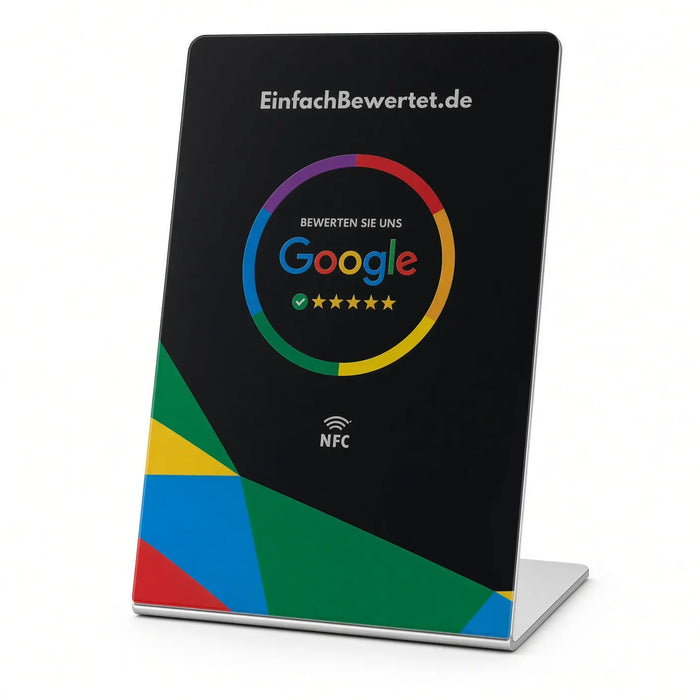
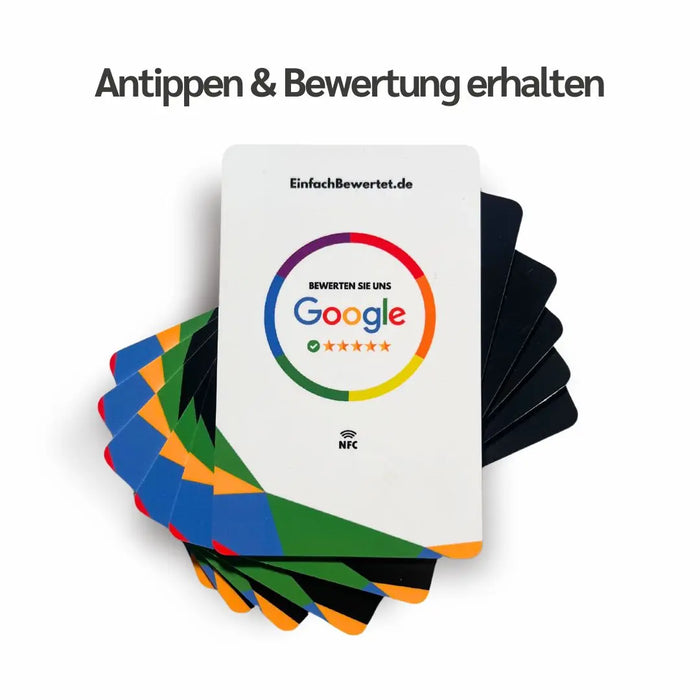
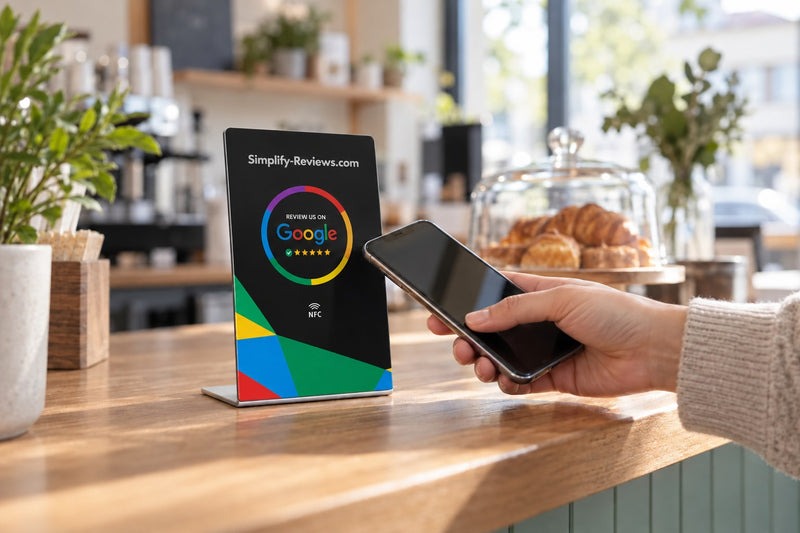
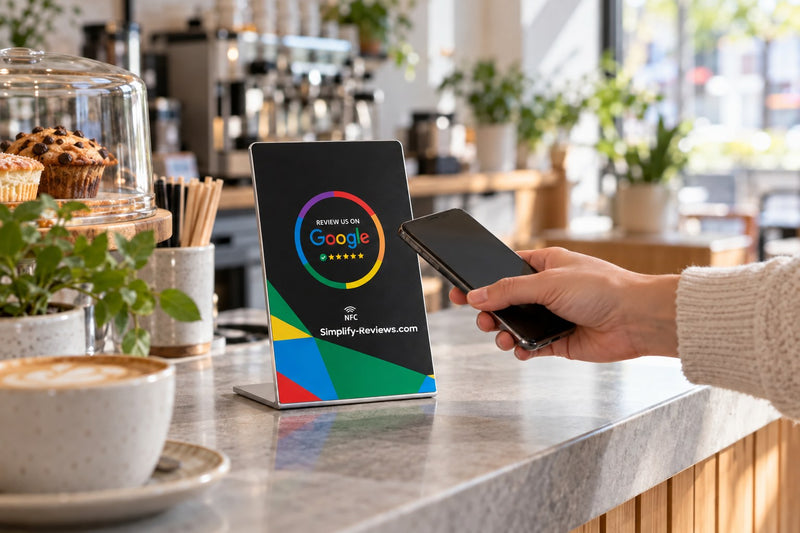
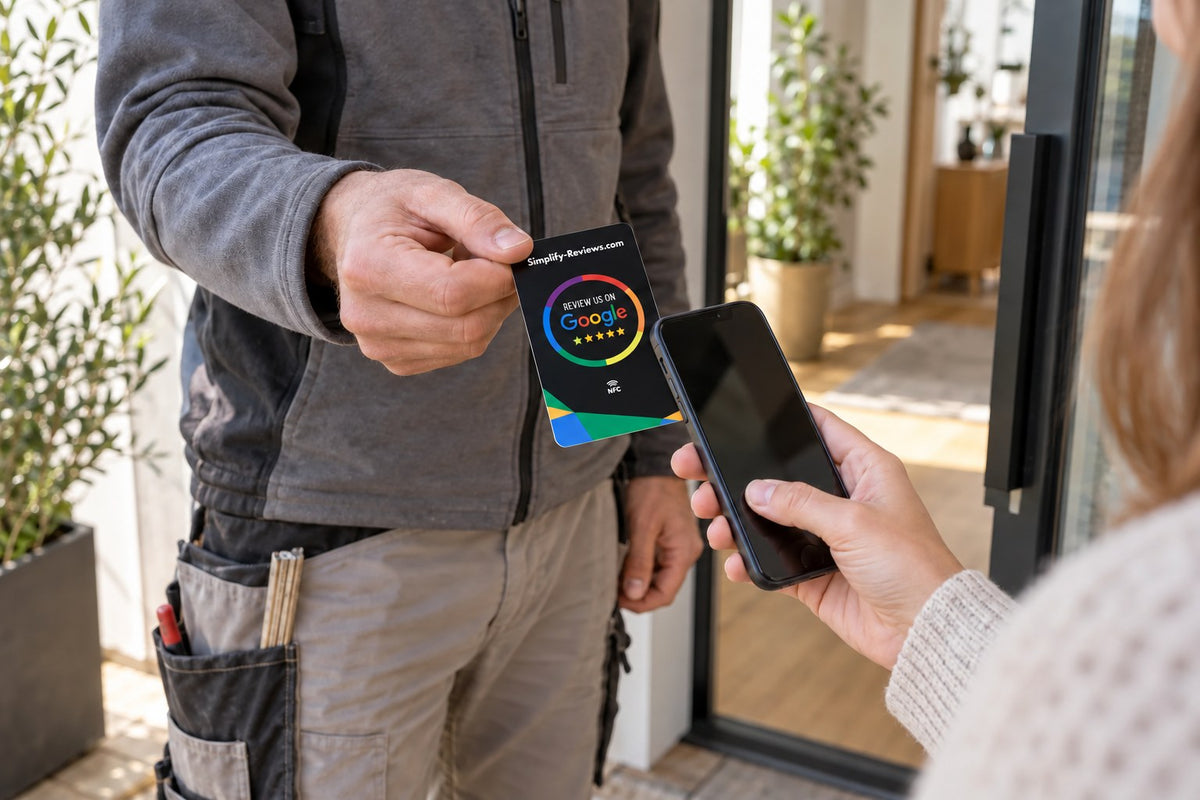
For mobile tradespeople, an NFC card in the vehicle or carried by the fitter often works well. For businesses with a reception area, showroom or consultation desk, a review display is more practical: the customer taps the display with their smartphone or scans the QR code if they do not use NFC.
The process should not depend on individual “motivated” employees. A simple rule is better: after every completed job, ask neutrally. No star requirement, no gift, no selecting only satisfied customers.
Which text templates work for fitters, the office and business owners?
Good templates are short, neutral and leave the customer completely free to decide whether and how they review.
Template for fitters at acceptance
“Thank you for letting us carry out the work for you. We ask our customers for honest feedback after every completed job. If you’d like to, you can review us directly here – one short sentence is enough.”
This wording is deliberately neutral. It does not ask for five stars, mention a reward or put the customer under pressure.
Template for the office after a phone follow-up
“I’m glad the job is complete. May I send you our review link by email or WhatsApp? The review is voluntary and helps other customers better assess our business.”
The key point here: first ask whether you may send the link. Review requests by email are legally considered advertising; the Munich Chamber of Commerce and Industry recommends explicit consent for this.
Template for WhatsApp or email after consent
“Good morning/afternoon Ms/Mr [Name], thank you for choosing us for your job. If you would like to share your experience with our business, you can voluntarily review us here: [Link]. Many thanks and kind regards, [Business].”
No request for specific content. No request for it to be “positive”. No consideration in return. You can find more wording examples in the article Asking customers for a review: templates & legal tips.
What is legally allowed: rewards, email, WhatsApp and review gating?
A neutral review request to genuine customers is allowed; rewards, pressure, purchased reviews and deliberately filtering out dissatisfied customers are risky or prohibited.
Google states that reviews must be based on real experiences. Incentives such as money, discounts, free products or services in exchange for reviews are prohibited; businesses must also not selectively request only positive reviews or suppress negative reviews.
For Germany, competition law rules also apply. Section 5b(3) of the German Unfair Competition Act (UWG) requires information on whether and how a business ensures that published consumer reviews come from actual users or buyers if it makes reviews accessible.
Especially important for trade businesses:
- No rewards: No discount, voucher, prize draw, free filter replacement or cash discount for reviews.
- No review gating: Do not first ask internally “Were you satisfied?” and then send only satisfied customers to Google.
- No pressure on site: Customers must be able to review voluntarily; nobody should stand next to them and monitor the review.
- No employee quotas: No targets such as “each fitter must get three reviews per week”.
- Check email and WhatsApp: Electronic review requests should only be sent with proper consent or after legal review.
This section does not replace legal advice. If you are unsure, have your specific communication checked by a specialist lawyer or your chamber.
Which technology is better: NFC display, NFC card, QR code or review link?
The best technology depends on where the final customer contact takes place: on site, at your premises, by invoice or digitally.
| Solution | Best suited for | Benefit | What to watch for? |
|---|---|---|---|
| NFC display | Reception, showroom, consultation desk, collection | Visible, stable, ideal for recurring customer contact | Add a QR code as a fallback |
| NFC card | Fitters, field sales, mobile acceptance | Fits in a vehicle or toolbox | Briefly train the team |
| QR code | Invoice, notice, completion folder | Works without NFC use | Print it large enough |
| Review link | Email signature, follow-up message | Fast to send digitally | Check consent and wording |
| Phone sticker | Owners, site managers, customer service | Always with you | Use without being intrusive |
NFC works with practically all current iPhones and Android smartphones. The QR code remains the fallback for older devices or customers who prefer to scan.
For tradespeople with a showroom or office, a display is especially simple: it stands where customers already wait, sign or receive advice. For businesses that work purely on site, a mobile card often makes more sense. The official review link or QR code can be created directly in the Business Profile.
How should trade businesses handle negative reviews properly?
You should first respond to negative reviews factually, then check them internally and only request removal where there are clear policy violations.
Not every bad review can be deleted. According to its own help pages, Google only removes reviews that violate policies; factual criticism usually remains visible.
A sensible process:
- Save a screenshot: Review, date, profile name, link, affected job.
- Check customer connection: Did this customer, job or contact exist?
- Respond factually: Briefly, without customer data, without arguing.
- Clarify internally: What happened? Are there photos, reports, invoices?
- Report only if there is a violation: Spam, insult, wrong location, no genuine experience, conflict of interest.
- Check one appeal: If the report is rejected, Google allows a one-time appeal under certain conditions.
Example response:
“Thank you for your feedback. Based on the information provided, we cannot yet clearly assign the described case. Please contact us at [Contact] so that we can review the matter and find a solution.”
For unjustified or suspicious reviews, a structured check can help; there is also a PDF guide to deleting unjustified Google reviews.
Which mistakes unnecessarily cost trade businesses reviews?
The most common mistakes are no clear responsibility, asking too late, overly complicated links and legally risky wording.
Many businesses do good work but only ask weeks later – or not at all. By then, the moment has passed. Customers have to log in again, search for the business, remember the job and take action themselves. Every additional step reduces the chance of a review.
Typical mistakes:
- Only asking satisfied customers: This is review gating and risky.
- Saying “Five stars would be great”: This influences the review.
- Offering vouchers: Incentives for reviews are prohibited.
- Linking to the wrong location: Especially with multiple branches or operating sites.
- Sending too many follow-up messages: This feels pushy and can be legally problematic.
- Leaving reviews unanswered: Replies show that feedback is taken seriously.
- No team briefing: Fitters do not know when and how to ask.
- Only running annual campaigns: Reviews should build continuously, not in bursts.
A good process does not need aggressive sales logic. It needs clarity: Who asks? When do they ask? Which link is correct? What is legally off limits?
What should larger trade businesses with several teams or locations keep in mind?
Larger businesses need clear review links for each location and team, clear responsibilities and consistent rules.

Illustrative image (AI-generated)
If a business has several branches, not every customer should be directed to the same profile. A job in Cologne should not accidentally be reviewed under the Düsseldorf location. Otherwise, local signals become diluted and customers read reviews that do not match their service area.
A simple structure makes sense:
- one verified Business Profile per location,
- a separate review link or QR code per location,
- one consistent neutral text template,
- brief training for fitters and office staff,
- monthly check: new reviews, replies, recurring points of criticism,
- no personal performance targets such as “x reviews per employee”.
For franchises, plumbing/heating/air-conditioning businesses with several customer service teams, roofers with several crews or landscapers with seasonal peaks, it is especially important that the review request does not feel chaotic. Customers should notice: the business asks professionally for feedback – not for favours.
Our view
We see the same pattern again and again with trade businesses: the quality of the work is good, but the review process is left to chance. A fitter asks sometimes, the office forgets the link, the QR code sits in a drawer and after three months the owner wonders why competitors with less experience get more visibility.
In our view, the most difficult part is not the technology, but the moment. The best review request happens when the customer can see the benefit right then: the new heating system is running, the bathroom is finished, the water damage has been repaired, the workshop has been left clean. That is exactly when the route to the review needs to be short.
We do not recommend aggressive review targets or star requirements. A calm standard process is better: ask every customer neutrally, offer direct access, follow up in a legally compliant way and respond to every review. Especially in the trades, current, specific reviews often have more impact than general advertising copy. They show that the business works reliably – in real houses, flats, commercial properties and neighbourhoods.
— Simplify Reviews Team
How we help
We set up review products so that customers land directly on the review form without having to search. For trade businesses with a reception area, showroom or consultation desk, the Google review display with NFC is especially suitable: tap, scan the QR code as a fallback, review. For mobile teams, we bundle suitable solutions under NFC for trade businesses. Businesses can also use a review link for the email signature if the legal requirements for sending have been checked. We explain how NFC, QR codes and review links work together on the page How our NFC products work.
Frequently asked questions
How many Google reviews does a trade business need?
There is no fixed minimum number that applies to every business. As a guide: the BrightLocal 2026 survey shows that 47% of surveyed consumers would not use a local business with fewer than 20 reviews – the study is US-based, but the trust effect is also relevant for German trade businesses. More important than a single target number is steady growth in current, genuine reviews.
Can I reward customers in Germany for a Google review?
No, you should clearly avoid this. Google prohibits incentives such as money, discounts, free products or services in exchange for reviews. In Germany, this can also be risky under competition law; have special cases checked legally.
Can I ask only satisfied customers for a Google review?
No, this is risky and does not correspond to a clean review process. Ask neutrally after every completed job or according to clearly defined criteria that do not depend on the customer’s mood. Dissatisfied customers must not be systematically intercepted while satisfied customers are forwarded to Google.
How can I have a negative Google review deleted?
You can report a review if it violates policies, for example in cases of spam, insults, conflict of interest or no genuine experience. Factual criticism generally cannot be removed. Secure evidence, respond calmly and use the official reporting tool.
Does the same process also work for car repair shops, clinics or restaurants?
Yes, the basic principle is similar: ask neutrally after a genuine contact and shorten the path to the review. For car businesses, the right moment is often vehicle collection; for clinics, after completed treatment, but only without pressure and with particular sensitivity; for restaurants, after the visit or via QR/NFC at the table. The legal boundaries – no rewards, no review gating, no star requirement – remain the same.
Sources
- Google Business Profile Help: Create a link or QR code to request reviews
- Google Business Profile Help: Tips for getting more reviews
- Google Business Profile Help: Prohibited & restricted content
- Google Business Profile Help: Improve your ranking in local search results
- Google Business Profile Help: Report inappropriate reviews
- Gesetze im Internet: Section 5b UWG – Material information
- Gesetze im Internet: Section 7 UWG – Unacceptable nuisance
- Munich Chamber of Commerce and Industry: Customer reviews online
- BrightLocal: Local Consumer Review Survey 2026
Read more
- Asking customers for a review: templates & legal tips
- Create a Google review link: guide
- Google reviews via NFC: more reviews for your business
Title image: illustrative image (AI-generated)