Types of NFC Tags: A Technical Comparison for Buyers and Developers
Discover the different types of NFC tags and find the ideal option for your application, with a focus on security and memory.
When choosing between types of NFC tags, three questions matter most: how much memory does your application need, what level of security is required, and which form factor suits the environment? The relevant chip families can be roughly divided into four groups: NTAG21x (NTAG213, NTAG215, NTAG216) for simple to medium-sized data sets, the MIFARE family (Classic, Ultralight C, DESFire EV1/EV2) for security applications, ICODE SLIX for longer read ranges in logistics, and Topaz512 as an older Type 1 option with limited memory.
For most marketing and business card applications, an NTAG213 with 144 bytes of usable memory is more than enough. As soon as you want to store several data records at the same time, such as a vCard and Wi-Fi access details, you will need NTAG215 or NTAG216. If the use case is access control or anti-counterfeiting, DESFire EV2 or cryptographically secured variants are usually the way to go.
The rule of thumb is: clarify memory first, then security, then form factor and environment, and only compare price at the end. If you reverse that order, you often end up buying tags that are too small or unnecessarily expensive.
- NTAG213: marketing, trigger links, simple URLs
- NTAG215/216: digital business cards, Wi-Fi pairing, larger NDEF data sets
- MIFARE DESFire EV1/EV2: access control, payment systems, security-critical processes
- ICODE SLIX: product labelling, supply chain applications with longer read distances
Key Takeaways
Choosing the right type of NFC tag primarily depends on the required memory, followed by security requirements, form factor and, only at the end, price.
| Topic | Details |
|---|---|
| Clarify memory requirements first | NTAG213 with 144 bytes is enough for URLs, while NTAG216 with — is suitable for extensive NDEF data. |
| Assess security correctly | MIFARE Classic is considered outdated, while DESFire EV1/EV2 offer 3DES/AES encryption for sensitive applications. |
| Check the NFC Forum type | Type 2 (NTAG) covers most consumer applications, while Type 5 (ICODE) is suitable for longer ranges. |
| Test form factor and environment | Proximity to metal and UV exposure require special inlays and weather-resistant carrier materials. |
| Test samples before placing a bulk order | A test tag in the target material reveals read and formatting problems early. |
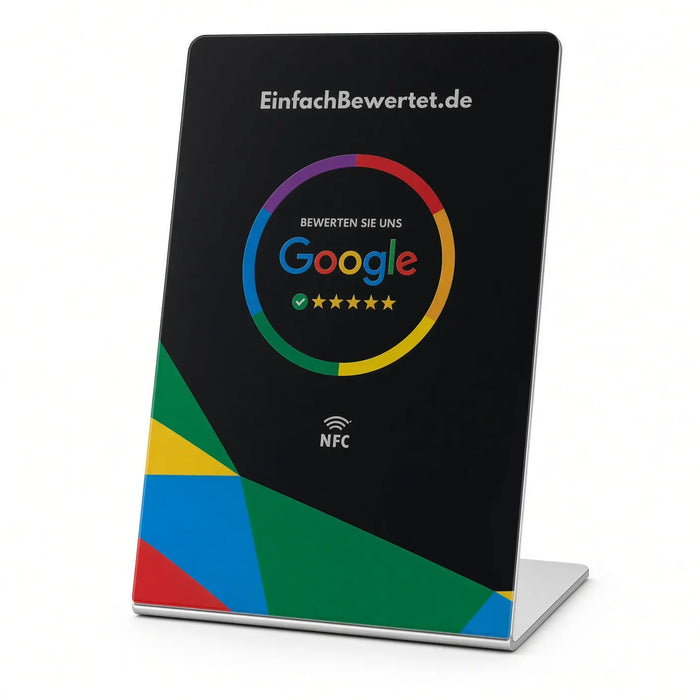
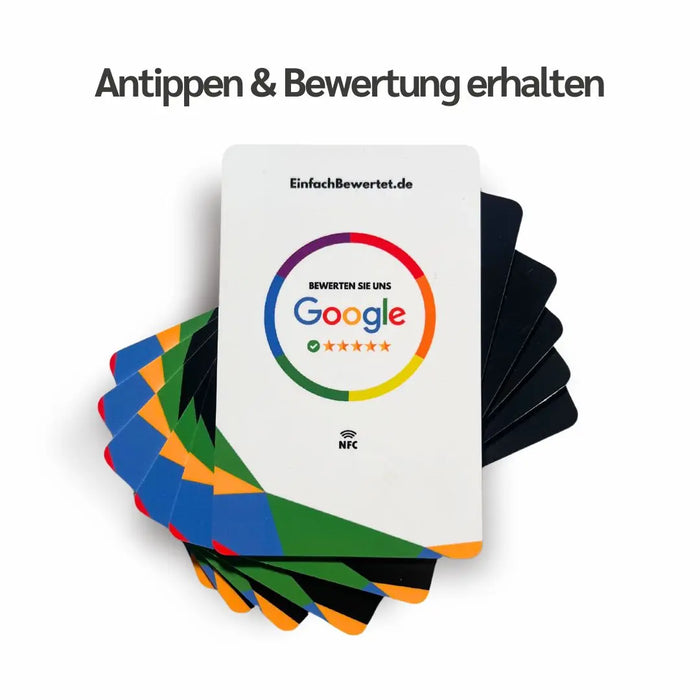
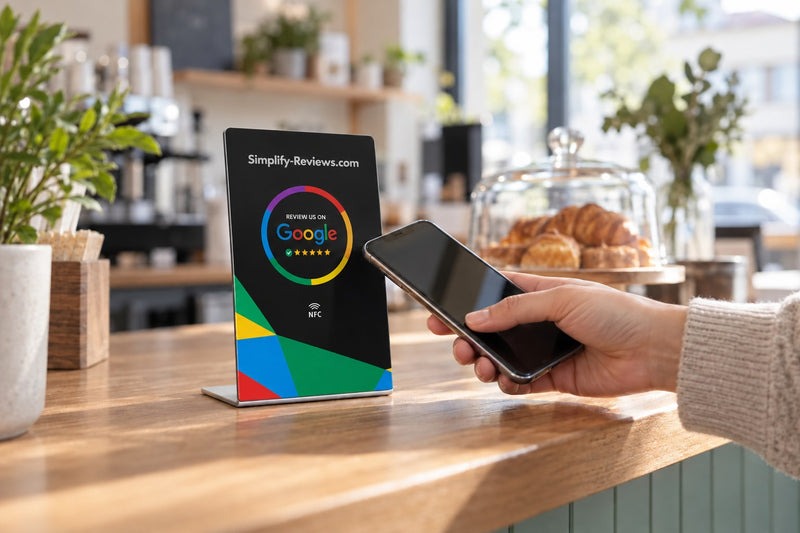
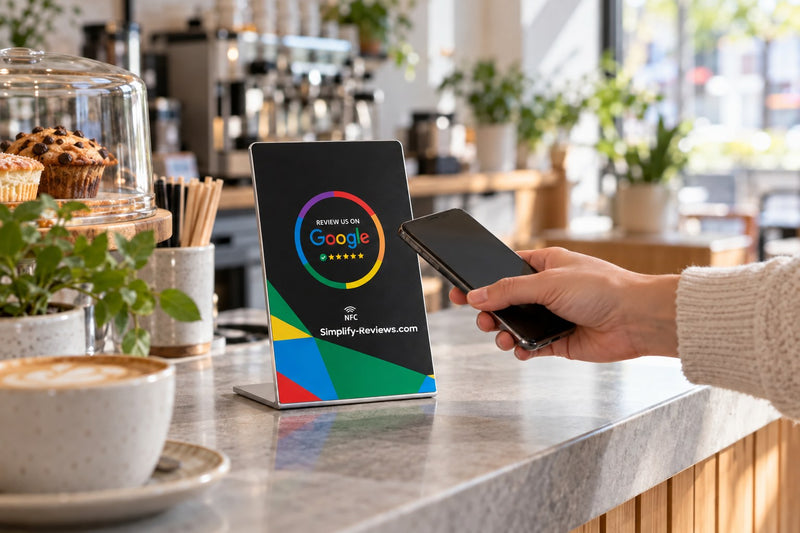
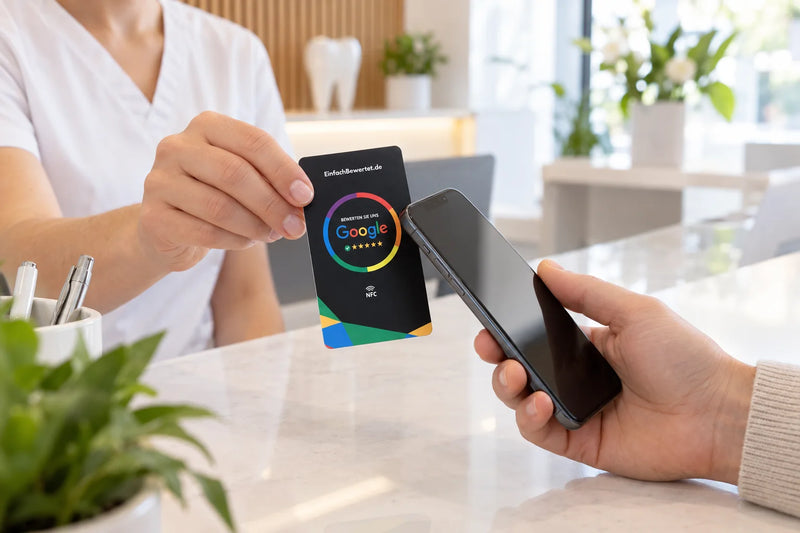
If you invest today in individually programmed NFC review cards or an NFC review display with your own logo, you benefit from exactly the chip quality described in this article: tested NTAG21x chips, cleanly integrated into the desired form factor and programmed ready for immediate use. Simplify Reviews handles the individual programming, including branding, and offers a money-back guarantee as well as free shipping, so customer-facing businesses can get started without technical risk.
Table of Contents
- Which technical features really distinguish NFC tag types?
- What do NFC Forum Types 1 to 5 mean?
- How do NTAG213, MIFARE and ICODE differ in detail?
- How do you choose the right NFC tag for your project?
- The most important specifications at a glance
- What is NFC technically, and why does NDEF matter?
- Which tag suits which real-world use case?
- Tips for avoiding common problems in use
- Environmental and sustainability aspects when choosing tags
- Sources
- FAQ
Which technical features really distinguish NFC tag types?
Four categories determine whether a tag is right for an application: memory, security, compatibility and form factor. If you ignore these four points, you may buy something that misses your actual needs.
The usable memory (user memory) determines how many NDEF records fit on the chip. An NTAG213 offers 144 bytes, which is enough for a short URL, but not for a complete vCard with a photo link and several contact fields. In that case, you need more headroom, such as with NTAG215 or NTAG216.
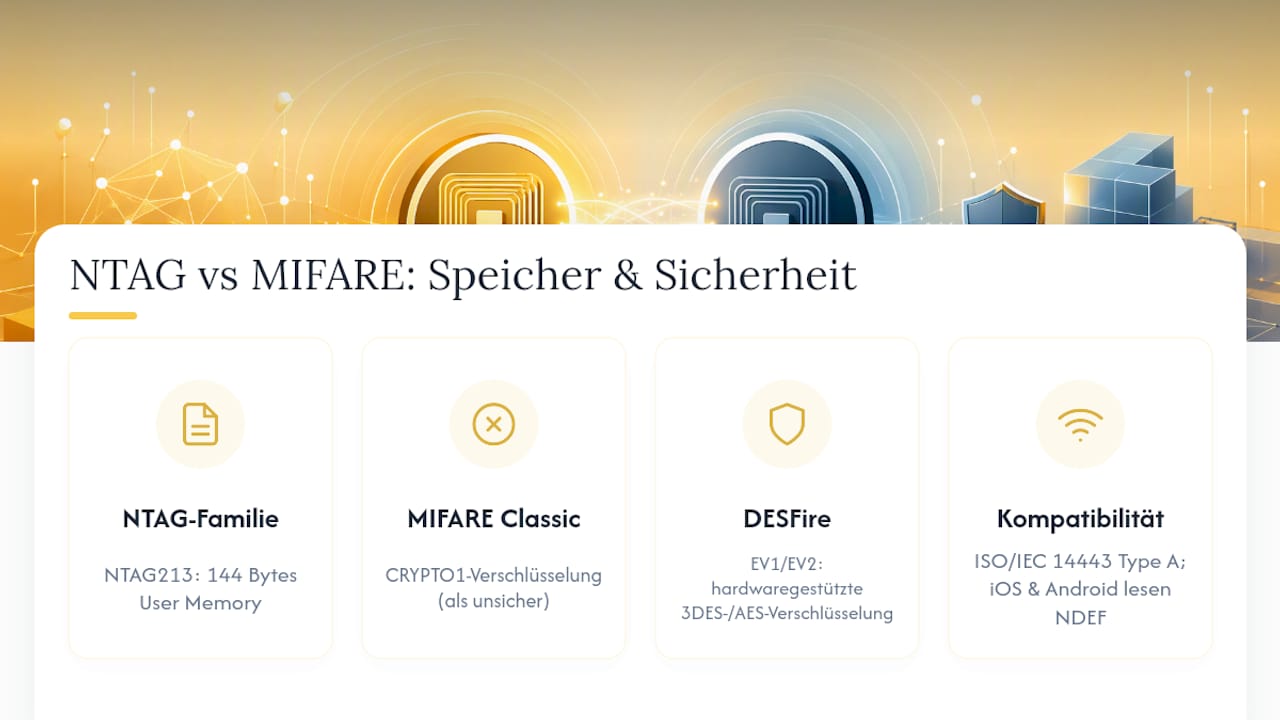
Security features vary greatly between families. NTAG chips offer password protection, an ECC-based originality signature for authenticity checks and lock bits to prevent later overwriting. MIFARE DESFire EV1 and EV2 go further and use hardware-supported 3DES or AES encryption, while MIFARE Classic relies on CRYPTO1 encryption, which is now considered insecure.
Compatibility depends on the NFC Forum type and the underlying ISO standard. Most consumer tags follow ISO/IEC 14443 Type A and can be read by iOS and Android devices without an additional app, provided the data is stored in NDEF format.
For service life, manufacturers state that many NFC tags support numerous write cycles and data retention over many years. Range and form factor depend heavily on antenna size and carrier material; a metal surface, for example, noticeably dampens the field.
Pro tip: Always order a test sample in the final form factor before larger production runs. A tag that works perfectly on a desk may suddenly be completely unreadable on a metal plate.
What do NFC Forum Types 1 to 5 mean?
The NFC Forum has standardised five tag types, which differ in memory architecture and underlying technology. This classification is older than many of the chip families sold today, but it still provides the framework manufacturers use.
- Type 1 is based on ISO/IEC 14443A, has limited memory and is now mainly represented by older chips such as Topaz512.
- Type 2 is by far the most common class. The entire NTAG21x family belongs here, as do many MIFARE Ultralight variants without a precise memory specification.
- Type 3 uses FeliCa technology, which is especially common in Japan for transit and payment systems.
- Type 4 is also based on ISO/IEC 14443, but supports dynamic memory and is often used for DESFire implementations.
- Type 5 follows ISO/IEC 15693 and enables longer read ranges, which is why ICODE chips are often assigned to this category.
For most marketing and business card projects, Type 2 is perfectly sufficient. As soon as a project requires access control or a longer reading distance in logistics, Type 4 or Type 5 becomes relevant. The NFC Forum also defines the NDEF format, which ensures that a smartphone interprets the data correctly regardless of the manufacturer. Without this standardisation, every app would need its own reading routine for every chip manufacturer.
How do NTAG213, MIFARE and ICODE differ in detail?
The chip family determines price, security and area of use in equal measure. It is worth taking a closer look here, because the differences between the families are greater than a superficial comparison might suggest.
NTAG213, NTAG215 and NTAG216
These three chips from NXP are NFC Forum Type 2-compliant ICs and form the backbone of almost every marketing or review application. NTAG213, NTAG215 and NTAG216 offer different memory sizes designed for different use cases. All three support a data rate of 106 kbit/s at 13.56 MHz and are designed for long-term use.
The additional functions are particularly interesting: UID ASCII Mirror allows the unique chip identifier to be automatically inserted into the transmitted URL, an NFC counter counts read operations, and the ECC-based originality signature is used for authenticity checks. Configurable password protection prevents third parties from overwriting the content. This exact combination of low price and solid basic features makes NTAG213 the standard chip for NFC review cards and similar applications with a single link.
For larger order quantities, the price difference becomes noticeable: NTAG213 is usually slightly cheaper than NTAG215, which matters when ordering several hundred or thousand units.
MIFARE Classic, Ultralight and Ultralight C
MIFARE Classic is one of the oldest and most widely used chip types overall, especially in access and transit cards. Its biggest weakness is CRYPTO1 encryption, which has been considered insecure for years and is no longer recommended for new security-critical projects. MIFARE Ultralight is a stripped-down, cheaper variant without noteworthy cryptographic functions, designed for single-use tickets. Ultralight C at least adds 3DES encryption and is suitable for applications with moderate security requirements, such as multi-journey tickets in local transport.
MIFARE DESFire EV1 and EV2
If you need truly robust security, it is hard to avoid DESFire. EV1 and EV2 use hardware-supported 3DES and AES encryption and achieve security certifications relevant for access systems, time tracking or payment applications. EV2 expands the number of possible applications on a single chip and improves key management compared with EV1. The price is noticeably higher than the NTAG family, but this is usually justified by the higher level of protection.
ICODE SLIX and Topaz512
ICODE SLIX belongs to Type 5 and stands out with a significantly longer read range of up to about 1.5 metres. This makes the chip interesting for product labelling and supply chain applications where tags need to be captured from a greater distance or while in motion. Topaz512 from Broadcom is a Type 1 chip with comparatively limited memory, now mainly found in older installations.
Pro tip: If you are choosing between NTAG215 and NTAG216, calculate the actual memory requirement of your NDEF message carefully. A complete vCard with several fields and a Wi-Fi data record often fills the 504 bytes of the NTAG215 almost to the limit.
How do you choose the right NFC tag for your project?
Before you contact a supplier, clarify five points internally. This will save you from repeat orders and poor purchasing decisions later.
- How many bytes does your NDEF message actually need? A single URL fits into 144 bytes, while a complete vCard with Wi-Fi access details needs significantly more.
- How often will the tag be written to? One-time programmed marketing tags have different requirements than systems that regularly write new data.
- What level of security is required? A restaurant table sticker does not need cryptographic protection; an access card does.
- Which form factor and material will be used? Proximity to metal often requires special anti-metal inlays.
- What does the operating environment look like? Moisture, UV radiation and temperature fluctuations can significantly shorten the lifespan of some carrier materials.
As a rough rule of thumb: NTAG213 is completely sufficient for simple marketing links and Google review requests. NTAG215 or NTAG216 become interesting as soon as several data fields need to be stored on the tag at the same time. DESFire EV1 or EV2 are mandatory as soon as real access control or payment security is involved.
When selecting a supplier, it is worth asking specific questions: Are free test samples available? How is the antenna layout designed in the desired form factor? Does the provider handle individual programming, including logo and branding, or do you have to do that yourself? And how do unit prices change at higher quantities?
The most important specifications at a glance
For a quick overview, it is worth comparing the eight most important chips side by side.
For purchasing decisions, three columns usually matter most: user memory, because it rules applications in or out from the start; security features, because they determine approval and liability; and relative cost position, because it becomes decisive at large quantities. NTAG213 is suitable for marketing and business cards, DESFire EV2 for access control and anti-counterfeiting, and ICODE SLIX for applications with longer read distances.
What is NFC technically, and why does NDEF matter?
NFC works via inductive coupling between a passive chip and an antenna at a frequency of 13.56 MHz. The typical range is around four centimetres, but it varies noticeably depending on antenna size, the field strength of the reader and the carrier material.
For a smartphone to interpret the data meaningfully at all, it needs a uniform format. That is exactly what NDEF (NFC Data Exchange Format) provides: it packages URLs, text data, vCards or Wi-Fi access details in a standardised way. NDEF formatting errors are among the most common reasons why a tag is not read on some devices, even though the chip itself works perfectly.
- 13.56 MHz operating frequency, passive chip without its own power supply
- Range usually below five centimetres, highly dependent on form factor
- NDEF ensures interoperability between manufacturers and operating systems
- ISO/IEC 14443 Type A is the relevant standard for most consumer tags
Many of the chips mentioned also follow ISO/IEC 14443 in parts 2 and 3, which define modulation and communication setup. If you comply with this standard, you reduce the risk that a tag will not be recognised cleanly by certain smartphones.
Which tag suits which real-world use case?
For pure URL forwarding, such as a trigger for a review page or a social media link, an NTAG213 is usually sufficient. As soon as a digital business card with full contact details or Wi-Fi access details is added, switching to NTAG215 is recommended. If you want to plan for the future and need to accommodate several NDEF records at the same time, you should go straight for NTAG216.
- Need only one URL or a simple trigger? Then choose NTAG213.
- Need a digital business card or Wi-Fi access details? Then choose NTAG215.
- Planning extensive data or several NDEF entries? Then choose NTAG216.
- Focused on access, payment or anti-counterfeiting? Then choose DESFire EV1, EV2 or specialised chips such as NTAG424 DNA.
In practice, this often looks like this: a smartphone sticker for Google reviews runs perfectly well with an NTAG213, while an access system for an office building simply does not offer sufficient security without DESFire encryption. Product labels in logistics that need to be scanned from a greater distance, on the other hand, benefit more from ICODE SLIX than from a classic NTAG chip.
Before placing a larger order, it is always worth doing a quick read test with the target device. Some older Android models and iPhones before iOS 13 show quirks with certain NDEF formats, which can be ruled out in advance with a single test sample. An overview of compatible devices can be found in the list of NFC-enabled smartphones.
Tips for avoiding common problems in use
The most common source of errors in NFC projects is not the chip itself, but the carrier material. Metal in the immediate vicinity of the antenna dampens the field so strongly that a tag becomes completely unreadable. An anti-metal inlay or a minimum distance of a few millimetres usually solves the problem reliably.

A second, often underestimated risk is formatting. Not every app writes in NDEF-compliant form, and some low-cost suppliers deliver tags with faulty structures that work on one smartphone but not on another. A test run with at least two different operating systems before rollout reveals these problems early.
Password protection sounds like a sensible additional safeguard, but it can become a problem if the access details are later lost and the tag needs to be reprogrammed. For simple marketing applications, a write-protected but unencrypted tag is often the more pragmatic choice.
Read distance is also often misjudged. Customers often expect NFC to work like Bluetooth over several metres, but in reality the range of most chips is only a few centimetres. A short instruction directly at the point of use, such as a small pictogram with “Place phone here”, noticeably reduces confusion and lowers the number of support requests.
Finally, for tags used outdoors, you should choose UV-resistant and waterproof materials. A display stand in direct sunlight will otherwise lose readability within a few months, not because of the chip, but because the carrier material has become brittle.
Environmental and sustainability aspects when choosing tags
NFC tags usually consist of a combination of plastic carrier material, a copper or aluminium antenna and the silicon chip itself. The environmental footprint depends heavily on how durable the chosen product is and what material the carrier is made from.
A rewritable NTAG chip with around 100,000 write cycles and data retention of about ten years does not need to be replaced for years, which gives it a clear advantage over disposable labels or printed QR codes. A once-programmed but physically robust display or review card can also often simply be rewritten during a rebrand or design relaunch instead of being completely replaced.
When choosing materials, it is worth looking at recyclable or bio-based plastics as carrier materials, provided the supplier offers this option. Packaging also plays a role: minimalist, reduced-plastic shipping packaging adds up to a noticeable reduction in waste for larger order quantities.
One often overlooked aspect is the longevity of the application itself. A tag that reliably performs the same function for years, such as collecting Google reviews at a restaurant counter, consumes significantly fewer resources over its lifetime than a system that has to be replaced every few months because cheap chips fail prematurely. If you choose tested branded chips such as the NTAG21x family instead of no-name products, you are indirectly buying a degree of sustainability as well.
Why sample tests often make the difference in the end
In practice, it is rarely the datasheet specification that decides the success or failure of a project, but the integration of the antenna into the actual form factor. Testing a sample in the target material before ordering a thousand units saves expensive rework.
Sources
FAQ
What are the best NFC tags for everyday use?
For marketing and simple URL links, NTAG213 is the most cost-effective and reliable choice. For security applications such as access control, MIFARE DESFire EV2 is a much better fit.
What exactly are NFC tags?
NFC tags are passive chips with an antenna that transmit data to a reader or smartphone via inductive coupling at 13.56 MHz, usually in the standardised NDEF format.
Which is better, RFID or NFC?
NFC is a subset of RFID with a shorter range and direct smartphone compatibility, while classic RFID is often used for longer distances and industrial logistics applications.
Which NFC tags have a long range?
ICODE SLIX chips compliant with ISO/IEC 15693 can reach distances of up to around 1.5 metres, significantly more than classic NTAG chips with their typical range of four centimetres.
What is the difference between NTAG213 and NTAG215?
NTAG213 offers 144 bytes of usable memory and is suitable for simple URLs. NTAG215 offers 504 bytes and is enough for complete vCards or Wi-Fi access details.